 Johan Trip· Co-founder~4 min readUpdated 3 Sep 2026
Dutch tax authority confirms: ERE payout for a company car is not wages
On 3 August 2026 the payroll-tax knowledge group of the Dutch tax authority published position KG:204:2026:16. The question: does the ERE payout for charging a company car at home constitute wages? The answer: no. Good news for every lease driver who charges at home • with one point to watch.
On 3 August 2026 at 14:50 the payroll-tax knowledge group of the Belastingdienst published position KG:204:2026:16. The question: does the ERE payout for charging an electric company car at home constitute wages? The answer: no.
That is good news for every lease driver who charges at home. We explain what it says, why it matches how the ERE system works, and the one point where you should pay attention.
What the tax authority says
The knowledge group tests the payout against the two routes through which something can be wages.
Wages from the employer. For that, the employer must provide the benefit and the benefit must be sufficiently connected to your employment. Neither applies here. The ERE payout does not come from your employer but from the market: fuel suppliers buy Emission Reduction Units because they are legally required to reduce their emissions. And according to the tax authority the benefit belongs to your personal sphere, not to your job.
Wages from third parties. Think of tips: a reward from someone other than your employer for what you do as an employee. That does not apply either. In the knowledge group's words: charging the company car is not work, and you do it not as an employee but as a private user of the electricity grid.
Not wages, then. No payroll tax on your ERE payout, even when the car belongs to the company.
Why this makes sense
It matches exactly how the Dutch renewable-energy-for-transport scheme works. ERE credits do not arise because a car drives, but because electricity flows through a grid connection. The rights belong to the EAN holder: the person in whose name the connection is registered with the grid operator. Not the leasing company, not the employer, not the owner of the car.
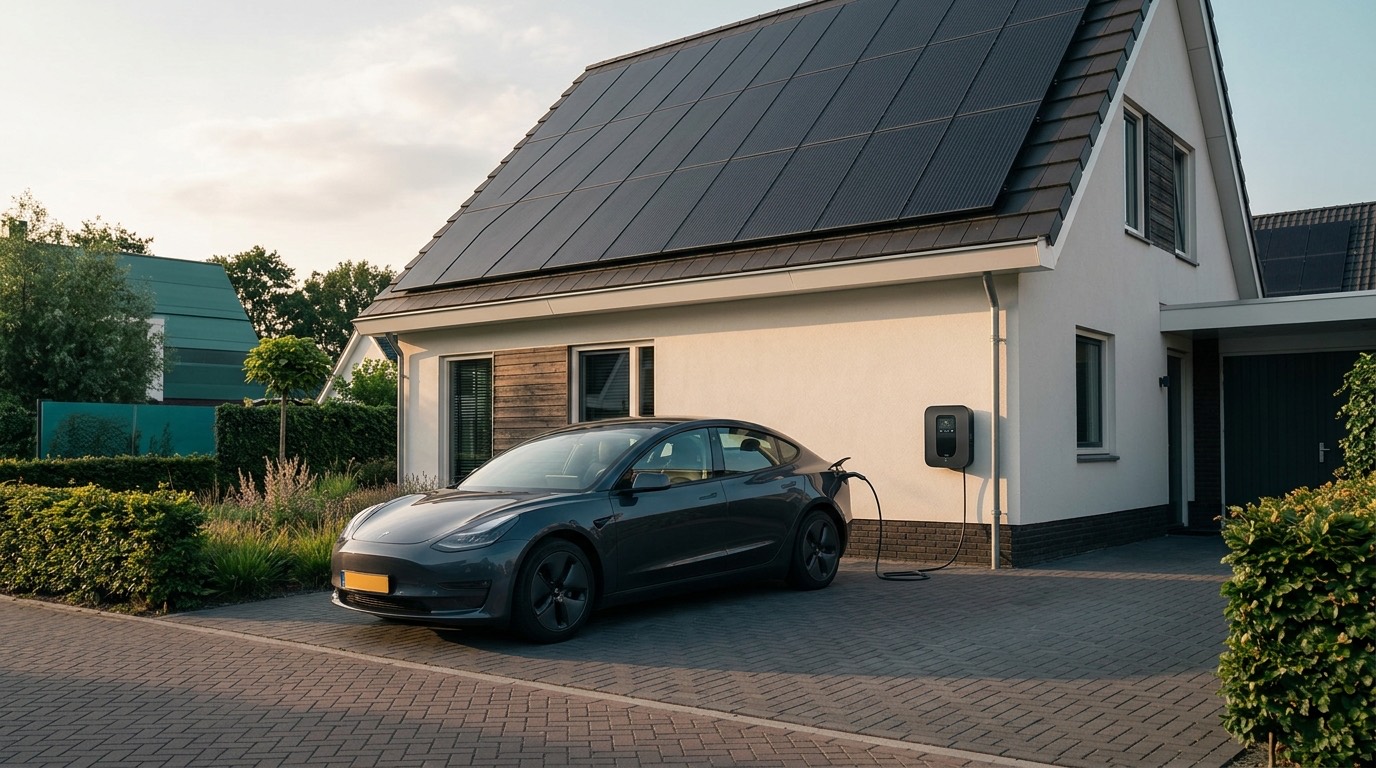
You charge at home, on your connection, with your charging station. The kWh are yours, the ERE credits are yours, the payout is yours. The tax authority now confirms that payroll tax does not come between you and that money.
The point to watch: do you expense your charging costs?
Many lease drivers expense their home-charging costs to their employer, often at the actual integral cost price per kWh. The knowledge group says something about that: the ERE payout lowers that integral cost price. If you receive an ERE payout per kWh, your cost price per charged kWh is lower on balance • and that can feed through into what you may expense to your employer.
There is one exception: if employer and employee make a businesslike arrangement for passing on energy at market rates, the ERE payout stays out of the equation. What matters then is the market price at the time of the agreement.
In practice: if you receive a charging-cost reimbursement from your employer, look at how it is set up. With a market-rate pass-on arrangement nothing changes. With reimbursement at integral cost price it is wise to review the arrangement with your employer.
Joulo is building a solution for this: a model pass-on arrangement between you and your employer, at a market-rate kWh price, generated straight from your dashboard. That keeps your charging-cost reimbursement fiscally clean and you keep your full ERE payout.
For lease drivers: your mandate is personal
One more thing this position implicitly confirms. The ERE payout belongs to you as a private user of the electricity grid • not to your employer, not to your leasing company. The mandate to a registration provider can only be issued by the EAN holder. That is you.
If your leasing company or charging-station operator proposes to "settle" the ERE proceeds in the charging rate or route them to the fleet manager: know that this is your money, that the choice of registration provider is yours, and that the tax authority has now confirmed that payroll tax does not come between you and it. Even when the charging station is company property: for ERE purposes the ownership of the station is irrelevant, the grid connection is what counts.
Is your charging station locked to your leasing company's or installer's platform? That is not a blocker: Joulo has already integrated most charging platforms, CPOs and charger brands • and if yours is not among them yet, we build the integration. Check your charging station via the compatibility check.
What this position does not say
The position concerns payroll tax only. The knowledge group makes no statement here about income tax. The reasoning • you receive the payout as a private user of the electricity grid, not as consideration for work • points the same way, but if you want certainty for your own situation, consult a tax adviser.
In summary
- The ERE payout for home charging a company car is not wages (KG:204:2026:16).
- No payroll tax, no withholding by your employer.
- The payout belongs to the EAN holder • you, not your employer or leasing company.
- If you expense charging costs at integral cost price, check your arrangement with your employer; with a market-rate pass-on arrangement this does not play.
- The mandate to a registration provider is personal and follows the EAN • your leasing company cannot issue it on your behalf.
Do you drive a company car and charge at home? On joulo.nl/en/company-car you can read exactly how to keep your ERE payout yourself. The full tax explanation is in our knowledge base: Do you pay tax on your ERE income?
Note
This article is a general explanation and not tax advice. Source: Knowledge groups of the Belastingdienst, KG:204:2026:16 (in Dutch). Consult a tax adviser for your own situation.
About the author
Co-founder of Joulo. Previously EV infrastructure at KPN and ServiceHouse. Writes about ERE, energy and regulation.

About Joulo
Joulo is an ERE booking service provider for residential charging sessions.
34,000,000 MID kWh this year (forecast)
The ERE backend for CPOs and energy companies, under their own brand.
White-labelJoulo B.V. • NEa-registered • in line with RED III
Get started
Earn money with home charging via ERE credits
Connect your charger, Joulo handles the rest. 20% standard service fee, lower through loyalty and referrals, cancel yearly, paid out quarterly.
Newsletter
Stay in the loop
The occasional email on ERE, chargers and earning from home charging. No spam, unsubscribe anytime.