Joulo sells its first two million Emission Reduction Units
Joulo completed its first two ERE transactions at the end of June: two million units in total, for gross revenue of €958,500. The revenue goes to connected EV drivers at the price actually realised, paid out every quarter.
 Joulo· Editorial~4 min readUpdated 30 Sept 2026
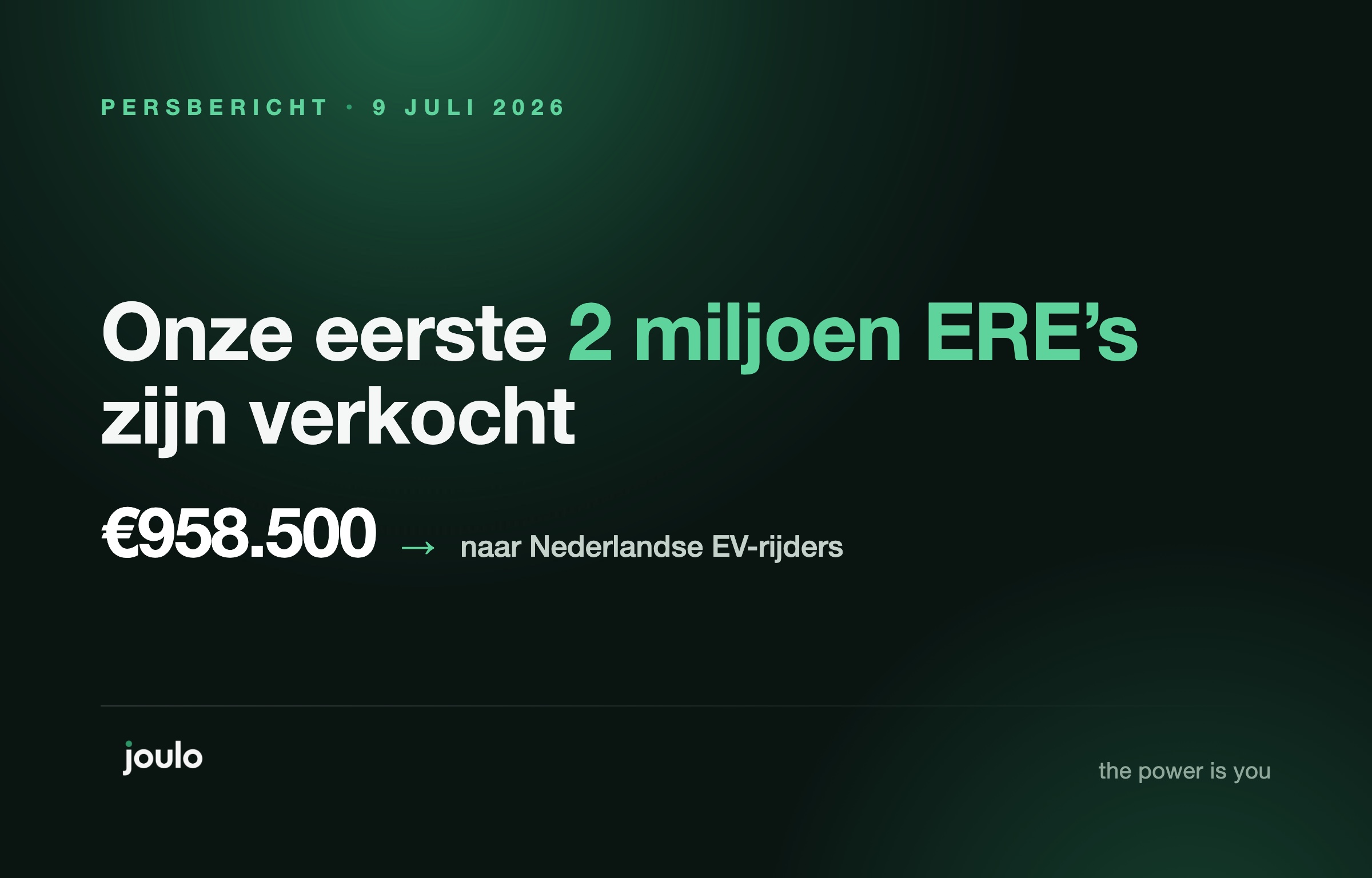
People who charge at home receive the market price actually realised, paid out every quarter.
Brummen, 9 July 2026 • Joulo, the Dutch platform that turns home charging into income, completed its first two ERE transactions at the end of June. It sold one million Emission Reduction Units (EREs) in each of two sales, together worth gross revenue of €958,500. The value of avoided CO₂ emissions thus flows back to the EV drivers who achieved that reduction. They did so by driving electric instead of filling up with fuel.
Joulo closed the transactions through the specialist brokers Evolution Markets and SFI Green Markets. On 26 June it sold 1,000,000 EREs (€0.4775 per ERE). On 29 June it sold another 1,000,000 EREs (€0.481 per ERE). The buyers are professional parties that buy the units to meet the fuel transition obligation (Brandstoftransitieverplichting). That obligation is not new: it builds on the HBE system that has existed since 2015. What is new since 1 January 2026 is that people who charge at home share in it too, through EREs. Joulo does not sell the electricity itself. It sells the emission reduction that arises when electricity replaces fossil fuel in transport. In the Energy for Transport Regulation, one ERE stands for one kilogram of avoided CO₂ emissions. The metered home charger makes that reduction measurable and tradable. The two million units sold therefore represent two million kilos of avoided CO₂ emissions. They were measured over just over six million kilowatt hours of electricity charged at home.
Actual market price, not an estimate
Joulo settles customer payouts at the price actually realised in the sale, not at a guide price estimated in advance. Each transaction is linked to a production quarter. The first sale covers charging sessions from the first quarter of 2026, the second sale the second quarter. As soon as the buyer has paid, connected drivers receive their share, minus only the service fee. Joulo bears the broker fees in full. Net, the payment for people who charge at home currently comes to about €0.13 per kilowatt hour charged.
Connected drivers now see the sale in their own dashboard. For each quarter it shows how many of their units were sold and at what price. That part is locked in and no longer moves with the market. The dashboard also shows how the current year builds up. It shows what has been paid out and what is ready to pay out. It also shows what is reserved in a running sale and what still has to be sold. It adds a forecast of the full year's earnings at the current market price.
The payout follows the pace of the NEa (the Dutch Emissions Authority). In mid-July, the NEa opens the accounts that registration service providers use to submit their registrations. Booking the charging sessions is therefore expected to take place in September. Once the units are booked and delivered and the buyer has paid, customers receive their payout. The customer does not have to do anything for this. That is the product.
"The market for Emission Reduction Units is young, but it works," says Harm Oosthoek, Head of Trade at Joulo. "In one week we contracted two professional buyers at prices above our own guide price. That revenue is for our customers. They get the price we actually realised, traceable to the cent for each charging session."
"These transactions show that registration service providers are quickly becoming important new participants in the Dutch ERE market," says Evan Ard, President of Evolution Markets. "The ERE market is becoming more operational as obligated buyers gain more confidence in this developing ecosystem. We are proud to have facilitated Joulo's first ERE transaction. With it, we helped build a transparent and well-functioning market for emission reductions in the transport sector."
Tens of thousands of households share in it
Joulo distributes the revenue from the first transaction over tens of thousands of connected households. Anyone who signs up later in the year still takes part retroactively. Charging sessions from 1 January 2026 count, even if the charger is connected to Joulo later.
"Anyone who charges at home with a charger with a built-in MID meter simply earns from this," says Johan Trip, Managing Director of Joulo. "You connect your charger once, and after that you do nothing. We read the sessions automatically, book them with the NEa and sell the units on the market. Every quarter, the money is in your account."
The ERE scheme stems from the European RED III directive. Fuel suppliers must reduce their emissions. To do so, they can buy Emission Reduction Units, which arise when electric cars are charged. The obligation rises over the coming years, which supports demand for EREs. ERE prices remain market-dependent. Joulo gives no price guarantees.
About Joulo
Joulo is a registration service provider and supplies the software that fully automates ERE registration. It takes three steps: 1) identify yourself via iDIN, 2) connect your charger, 3) authorise Joulo for your connection (EAN). After that, everything happens automatically. Joulo reads every charging session via cloud API or OCPP and validates the MID meter. It traces every kWh back to its session and books it with the Dutch Emissions Authority (NEa). It trades the resulting EREs on the emissions market on the customer's behalf and pays out every quarter. More information: www.joulo.nl.
About the author
The Joulo team. ERE booking service provider for home charging sessions. the power is you • platform for electric driving.

About Joulo
Joulo is an ERE booking service provider for residential charging sessions.
34,000,000 MID kWh this year (forecast)
The ERE backend for CPOs and energy companies, under their own brand.
White-labelJoulo B.V. • NEa-registered • in line with RED III
Newsletter
Stay in the loop
The occasional email on ERE, chargers and earning from home charging. No spam, unsubscribe anytime.
Earn on every kWh you charge at home
Connect your charger once. We register your sessions and pay out every quarter. 20% service fee, cancel yearly.