Net metering ends in 2027: charge on your own solar and earn EREs
The net metering scheme (salderingsregeling) ends on 1 January 2027, and charging your car on your own solar becomes the biggest lever in your home. Separately, every kWh charged at home earns EREs: what changes, what you need and what it earns.
 Johan Trip· Co-founder~7 min readUpdated 30 Sept 2026
Good to know
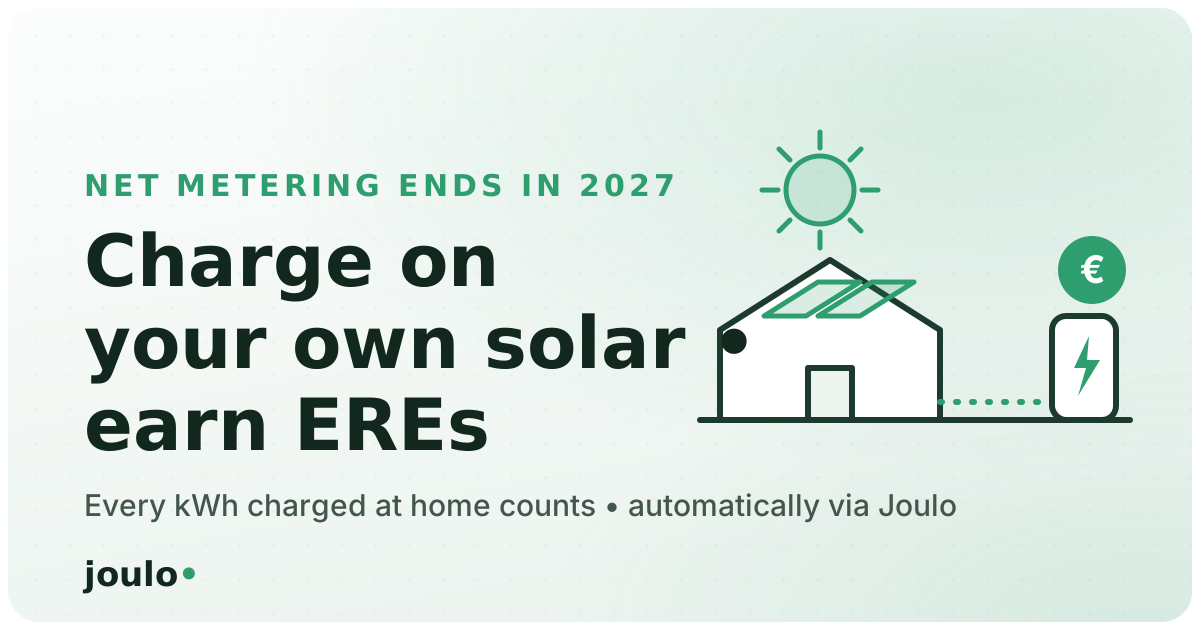
The net metering scheme (salderingsregeling) ends on 1 January 2027. For the solar power you export, you then only get a feed-in payment. Until 2030 it is at least half the bare supply rate. So every kWh you use yourself straight away becomes worth more. Charging your car on your own solar is the biggest lever in your home for that. Separately, every kWh charged at home has earned EREs since 2026. Joulo customers get an average of 12.6 cents net per kWh.
Two schemes decide what your own electricity is worth in the coming years. One ends: on 1 January 2027 the net metering scheme for solar panels disappears. The other has run since 1 January 2026: every kWh charged at home earns Emission Reduction Units, EREs for short. Both reward the same behaviour: charging on your own electricity.
What changes on 1 January 2027
With the net metering scheme, you offset the solar power you export against electricity you take from the grid at another time. A kWh you export in June offsets a kWh you use in December. That includes energy tax. So the grid works as a free battery.
That ends on 1 January 2027 (Dutch government). For the power you export, your energy supplier then pays you a feed-in payment. Until 2030 it is at least half the bare supply rate: the electricity rate without taxes. Many suppliers also charge feed-in costs.
Electricity you use yourself straight away costs you no tax and no supplier costs. So a kWh from your roof that you use yourself saves you the full rate. A kWh you export earns less than half of that at the minimum.
So after 2027 you do not want to sell your solar power. You want to use it.
Your car is the biggest load you can control
Most appliances run when you need them. Your car does not: it stands still most of the day and only needs to be full later. That is why charging is the easiest way to use more of your own electricity.
Our customers charge 4,100 kWh a year at home on average. If you charge part of that during sunny midday hours, your solar output goes straight into the battery. You then do not export that power for a low payment, and you do not buy it back later at a high price.
You can do this by plugging in the cable when the sun shines. It can also run automatically: many chargers have a solar mode that adjusts the charging current to your surplus. How net metering, solar panels and your charger fit together after 2027 is explained in our knowledge base.
One thing to watch: do not charge all day at very low power. Below 2.6 kW your car loses a larger share of the electricity. Charge in blocks at higher power instead.
Separately: EREs on every kWh charged at home
Since 1 January 2026, every kWh charged at home earns EREs. One ERE stands for 1 kilogram of avoided CO2 emissions, because you drive electric instead of on petrol or diesel.
The Dutch Senate (Eerste Kamer) passed the law on 31 March 2026. Fuel suppliers must cut their emissions further every year. The obligation rises from 14.4% in 2026 to 28.4% in 2030. To meet it, they buy EREs, and that demand gives your charging sessions value.
As a private individual you cannot book with the NEa (the Dutch Emissions Authority) yourself. A registration provider does that. It reads your charging sessions, books them, sells the EREs and pays you. With Joulo you connect your charger once. We do the rest and pay out every quarter.
The NEa calls it a market system: the price of EREs moves with supply and demand. What our customers have received so far is a fact. Joulo customers get an average of 12.6 cents net per kWh, and 12 cents at the 20% service fee. Over 4,100 kWh that is an average of €517 a year. Every sale is in our open sales log.
Do your solar panels count twice? No
A common mistake: "I charge on my own solar power, so my kWh are 100% green and earn more EREs." That is not how the scheme works.
For home charging, the NEa uses the average renewable share of the Dutch electricity mix. That is 50.5% for 2026, whatever is on your roof. There is no separate line between your panels and your charger, so nobody can prove which kWh came from your roof.
So your solar panels earn no extra EREs. Their benefit is in the electricity itself: it comes from your roof, and after 2027 charging on it directly saves you the difference between the supply rate and the feed-in payment. The EREs are separate from that.
What you need to take part
- A charger with a factory-fitted MID meter. A separate meter in the meter cupboard does not count for home charging. Not sure about your model? Use check your charger.
- Complete session data. We book based on the complete charging sessions from your charger's backend. A photo of a meter reading is not a valid measurement source. At Joulo this runs through the connection with your charger.
- The connection in your name. The connection of your charger must be in your name in the Central Connection Register (Centraal Aansluitingenregister).
- One authorisation per connection. You authorise one registration provider per connection, per calendar year. You cannot switch during the year. So compare the costs and how payouts work before you choose.
Good to know
Joulo B.V. has an account in the REV (Register Energy for Transport) of the NEa. An account is a registration, not a quality assessment. So check for yourself what a provider pays out, how it reads your data and how you cancel.
2026 still counts
Charging sessions from 1 January 2026 count if you sign up by 25 February 2027 at the latest. The condition is that a MID meter measured them and that they can be retrieved in full from your charger's backend.
Do not wait until just before that date. When you connect, we retrieve your sessions from 1 January 2026, as far as the manufacturer or the platform keeps that history. The sooner you connect, the more certain it is that this history comes in.
No MID meter yet? Then your sessions count from the moment you have one. They cannot count retroactively.
What EREs do not do
EREs do not replace the net metering scheme. They are two separate schemes:
- Net metering is about your generation. EREs are about the electricity you charge. If you charge little at home, you get few EREs, however much solar is on your roof.
- The ERE price moves with the market. What customers have received so far is fixed. What the next sale earns is not.
- Your registration provider charges a service fee on the gross revenue.
For a household with solar panels, the end of net metering costs money. How much depends on your generation, your usage and your contract. Charging on your own solar limits that loss. The EREs come on top of that, separately.
Further reading
- Solar panels, net metering and your charger after 2027
- What are EREs and how do they work?
- What we get for your EREs, sale by sale
- Check whether your charger is suitable
Sources
Frequently asked questions
Do I get more EREs because I have solar panels?
No. For home charging, the NEa uses the fixed renewable share of the grid, 50.5% in 2026. Your own generation does not count in that. Your benefit is in the electricity from your roof, not in extra EREs per kWh.
Can my charging sessions from 2026 still count?
Yes, if you sign up by 25 February 2027 at the latest. A factory-fitted MID meter must have measured the sessions, and they must be retrievable in full from your charger's backend.
Do EREs replace the net metering scheme?
No. Net metering was about your solar power, EREs are about the electricity you charge. What EREs earn depends on how much you charge at home and on the market price.
What does it cost through Joulo?
A 20% service fee on the ERE revenue. Cancellable annually, paid out every quarter. You see every charging session and every payout in your dashboard.
About the author
Co-founder of Joulo. Previously EV infrastructure at KPN and ServiceHouse. Writes about ERE, energy and regulation.

About Joulo
Joulo is an ERE booking service provider for residential charging sessions.
34,000,000 MID kWh this year (forecast)
The ERE backend for CPOs and energy companies, under their own brand.
White-labelJoulo B.V. • NEa-registered • in line with RED III
Newsletter
Stay in the loop
The occasional email on ERE, chargers and earning from home charging. No spam, unsubscribe anytime.
Earn on every kWh you charge at home
Connect your charger once. We register your sessions and pay out every quarter. 20% service fee, cancel yearly.