Single-phase or three-phase charging: what difference does it make?
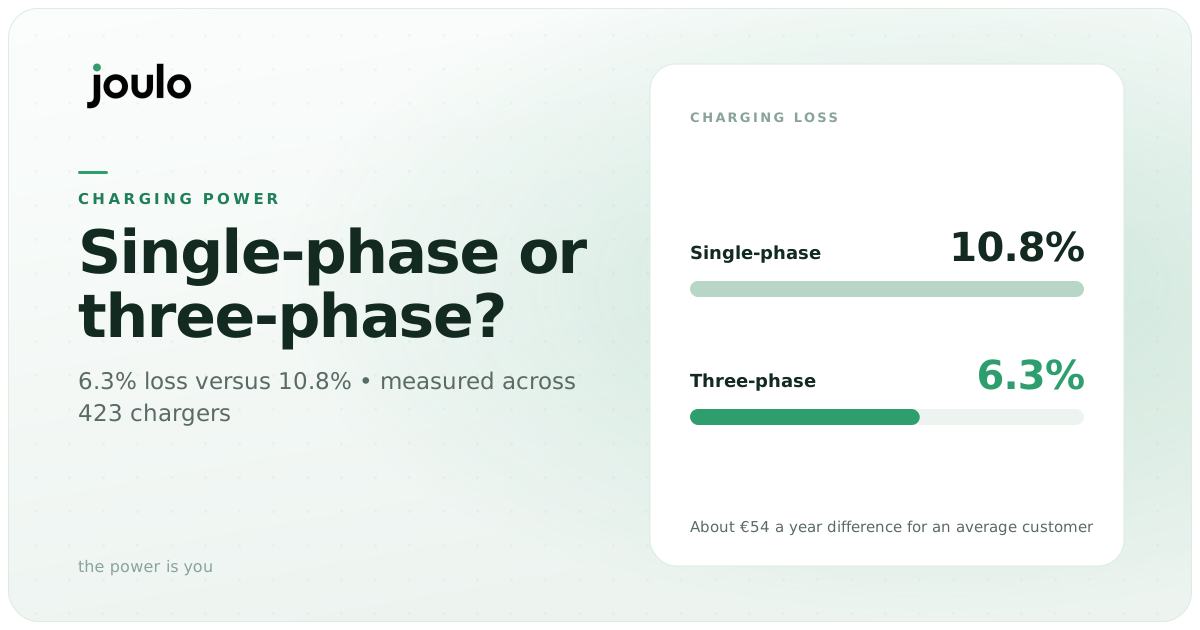
On three-phase you lose about 6.3% of your charging electricity, stuck on single-phase 10.8%. For an average customer that is about €54 a year in electricity, €269 over five years, so charge on three phases if you can.
 Johan Trip· Co-founder~6 min readUpdated 30 Sept 2026
Good to know
At full three-phase power, about 6.3% of your charging electricity is lost in the car. If you are stuck on single-phase, that is 10.8%. A gap of more than four percentage points. It is not your charger: almost every device in the single-phase group can do 11 to 22 kW by its own specification. It is your connection, or a current limit that someone set. For an average customer that costs about €54 a year in electricity, €269 over five years. Charge on three phases if you can.
Two chargers, same brand, same model, same car. One charges the car full in two hours, the other takes six. At the end of the year, the second has pulled more electricity from the meter for exactly the same kilometres.
That is not down to the charger. It is down to the number of phases.
What single-phase and three-phase mean
Dutch homes have a connection with 1 phase or with 3 phases. At 16 amps per phase, that is the difference between 3.7 kW and 11 kW. Same current, three times the power.
| connection | at 16A | at 32A |
|---|---|---|
| 1 phase | 3.7 kW | 7.4 kW |
| 3 phases | 11 kW | 22 kW |
For your battery, it does not matter how fast you charge. For your electricity bill, it does, and that comes down to something most people do not know.
Why slow charging costs more electricity
While charging, your car does more than fill the battery. The charging electronics are on, the battery management measures along, and the cooling does its job. ADAC measures 100 to 300 watts for this, for the whole charging session.
Those 200 watts run just as hard at 11 kW as at 3.7 kW. But at 11 kW you are done in two hours, and at 3.7 kW you charge for six. The same overhead, three times as long. On top of that, the converter in your car itself works less efficiently when little current flows through it.
In August 2026, ADAC charged five cars with 30 kWh per test. It then set the grid meter against the energy that actually reached the battery:
| charging power | measured charging loss |
|---|---|
| 11 or 22 kW | 5.1 to 7.0% |
| 4.1 kW | 8.0 to 12.8% |
| 2.3 kW wall socket | 12.7 to 24.2% |
ANWB measured the same pattern earlier on four other cars: 6.3 to 9.7% at 11 kW, and 9.2 to 13.9% when you turn that same charger down to lower power.
The loss also rises sharply within one car. One measured 11 kW onboard charger reaches 97% efficiency at 32 amps and 80% at 2 amps (Energies, 2024).
What we measure across our customers
We do not see the loss itself. Our MID meter sits before the car, so we measure what goes into the car, not what arrives in the battery. What we do see precisely is the power. A charger that connects through OCPP sends a meter reading every two to three minutes. The difference between two readings is the real power at that moment.
For the chargers that report their meter readings through OCPP, we see the power every few minutes. We grouped them by the power they actually reach. Not by what the device can do, but by what passes through the meter.
| how the charger charges | share | calculated loss |
|---|---|---|
| stuck on single-phase, maximum about 3.7 kW | 13% | 10.8% |
| maximum 4 to 6 kW | 8% | 9.9% |
| maximum 7 to 9 kW | 10% | 8.2% |
| reaches full power, but often turns down | 21% | 9.0% |
| reaches full three-phase power | 50% | 6.3% |
Half of the chargers sit in the most favourable group. And about one in eight is stuck on single-phase, with more than four percentage points more loss.
Those percentages are the measured power distribution times the ADAC curve. So it is a calculation on our own data, not a measurement of your battery.
It is not your charger
This was the surprise in the figures. We looked up the models of the chargers that are stuck on single-phase. Almost all of them are listed in our catalogue as 11 to 22 kW. The hardware is not what holds them back.
A charger does not convert anything either. It switches alternating current through and measures it. The conversion to direct current happens in your car, and that is where the loss arises. We see that in the data. Put two chargers of different brands on the same connection, with the same setting. Then we measure the same loss for both. Across all brands in our measurement, the difference within the same charging mode is less than a tenth of a percentage point.
So what is it?
- Your connection. Many homes have 1 phase. That is not a choice you make at the charger, but in your meter cupboard.
- A current limit. Sometimes the charger is set low on purpose, for load balancing or to protect the main fuse.
- Smart charging or solar surplus. Both turn the power down. That is the group that can reach full power but often turns down, about one in five.
Five years on single-phase versus three-phase
What does that difference really cost? Our customers charge 4,100 kWh a year at home on average, about 20,500 kilometres. On three-phase, 3,842 kWh of that ends up in your battery. To get the same 3,842 kWh into your battery on single-phase, you pull 4,307 kWh from your meter.
| over five years | full three-phase | stuck on single-phase |
|---|---|---|
| loss | 6.3% | 10.8% |
| in your battery | 19,209 kWh | 19,209 kWh |
| from your meter | 20,500 kWh | 21,534 kWh |
| electricity at €0.26 per kWh | €5,330 | €5,599 |
The single-phase route takes 1,034 kWh extra from your meter over five years. That is €269 in electricity, about €54 a year. For exactly the same kilometres.
That money is gone. You get nothing for it: the car has gone no further and the battery is no fuller.
How do you know which group you are in?
Take a charging session in which your car went from fairly empty to full. Divide the kWh by the number of hours it actually charged. If you land around 3.7 kW and never higher, you charge on 1 phase. If you land above 7 kW, you have 3 phases or a single-phase connection of 32 amps.
Not sure? Our support team will look at your own charging sessions with you. Send a message through your dashboard.
Charge on three phases
Do you have 3 phases in your meter cupboard, and does your charger still charge at 3.7 kW? Then a limit is set, for load balancing or to protect the main fuse. Ask your installer to check it. Often there is room, and then you save four percentage points at no cost.
Do you have 1 phase? Then upgrading your connection is the only way to three-phase charging, and that costs money. Ask your grid operator for the price. That €54 a year alone rarely pays back a heavier connection. Do it for the rest. You charge three times as fast, there is room for a heat pump or a home battery, and a second car fits too. Less charging loss is then a bonus on top.
Further reading
About the author
Co-founder of Joulo. Previously EV infrastructure at KPN and ServiceHouse. Writes about ERE, energy and regulation.

About Joulo
Joulo is an ERE booking service provider for residential charging sessions.
34,000,000 MID kWh this year (forecast)
The ERE backend for CPOs and energy companies, under their own brand.
White-labelJoulo B.V. • NEa-registered • in line with RED III
Newsletter
Stay in the loop
The occasional email on ERE, chargers and earning from home charging. No spam, unsubscribe anytime.
Earn on every kWh you charge at home
Connect your charger once. We register your sessions and pay out every quarter. 20% service fee, cancel yearly.