Market & prices
ERE prices, supply and demand • what the market does and why it matters for your payout.
All articles
Search by topic, brand or keyword.










Market
Who controls your charging data? One year of the Data Act
Every kWh charged at home is worth money, so whoever controls your charging data controls your earnings. One year after the Data Act: which patterns lock you in, and what can you do yourself?
Market
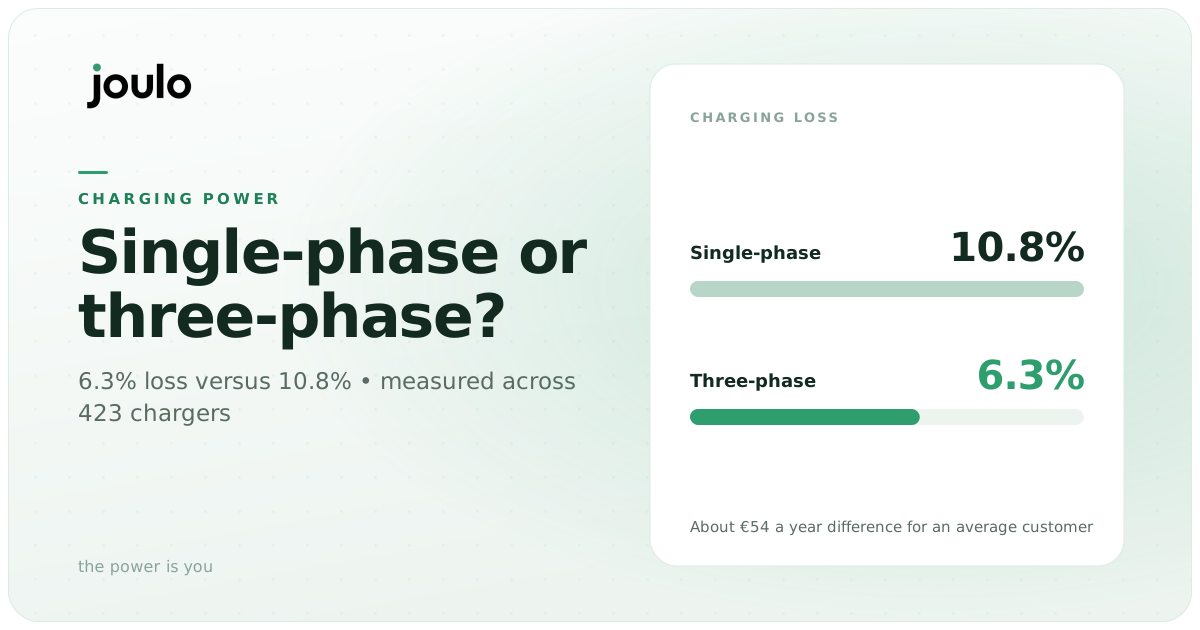
Single-phase or three-phase charging: what difference does it make?
On three-phase you lose about 6.3% of your charging electricity, stuck on single-phase 10.8%. For an average customer that is about €54 a year in electricity, €269 over five years, so charge on three phases if you can.
Market
Smart charging at home: who really does it, and why lease drivers don't
Households with a dynamic contract charge differently: around noon, while the rest charge at five. We put three months of charging sessions next to household, charger and energy supplier.
Market
What does home charging earn with ERE? A per-kWh and per-year example
How much can you really earn charging at home? An honest answer with a worked example you can check yourself: around €0.13 net per kWh.
Market
Open charging market or closed portal: the choice is being made now
The market for home-charging credits has just opened. The technical choices being made now • who may access your charging data, and by which route • will determine for years whether you choose your registration provider, or your charger portal does it for you.
Market
Tibber + Joulo: a double win for EV drivers
Smart charging through Tibber and ERE income through Joulo. How the two stack, and why your energy contract does not affect your ERE payout.
Market
How Joulo sells on your behalf: from kWh to quarterly payout
Part 6, the finale of our series on ERE trading. How Joulo pools your charging sessions, sells them at market price and pays out quarterly, net of the service fee.
Market
Your charging data is yours. And here is how we keep it that way.
Who may access your charging sessions, and who decides? The starting point is simple: your charging data is yours. What that means for your authorisation, your EAN, and what Joulo does and does not do.
Market
The cost of charging an electric car in the Netherlands (2026)
At home you charge for around €0.28 per kWh, at a public charger you pay about double, and fast charging costs even more. The figures for 2026, the sum per year, and the cheapest place you may overlook.
Market
Why the ERE price rose nearly 7% last week
Oil got cheaper last week after Trump announced a deal with Iran, and that is exactly why the ERE price rose by nearly 7%. Counter-intuitive, we know. Here is how it works, and what it means for your payout.
Market
The Dutch Energy for Transport Regulation is now official: how ERE registration works for home chargers from 2026
On 5 May 2026, Stcrt. 2026 nr. 15748 was published in the Staatscourant • the RED III implementation regulation. It applies retroactively to 1 January 2026. Here's what it means for you and ERE registration.





Newsletter
Stay in the loop
The occasional email on ERE, chargers and earning from home charging. No spam, unsubscribe anytime.