Smart charging at home: who really does it, and why lease drivers don't
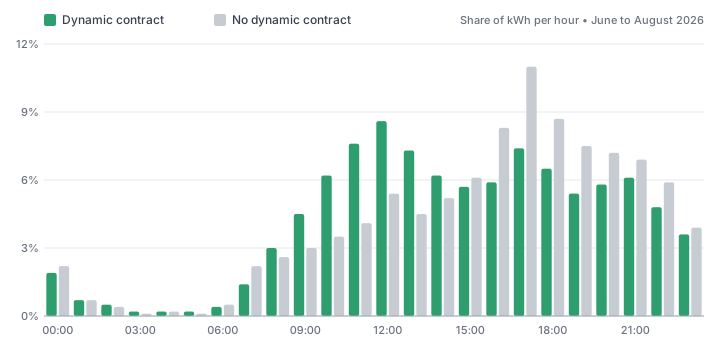
Households with a dynamic contract charge differently: around noon, while the rest charge at five. We put three months of charging sessions next to household, charger and energy supplier.
 Johan Trip· Co-founder~6 min read
Smart charging is simple: your car charges in the hours when electricity is cheap. Sounds logical. But do households actually do it?
We put the charging sessions from June to August 2026 next to three things we know about a household. The household profile: dynamic contract, solar panels, home battery, heat pump, lease or privately owned car, smart control. The energy supplier. And the charger brand.
Dynamic contract: charging at noon
Put the sessions of households with a dynamic contract next to those without, and the whole day shifts.
| Time of day | Dynamic contract | No dynamic contract |
|---|---|---|
| Night (23:00 to 07:00) | 8% | 8% |
| Morning (07:00 to 10:00) | 9% | 8% |
| Midday (10:00 to 16:00) | 42% | 29% |
| Evening peak (17:00 to 21:00) | 25% | 34% |
Share of charged kWh per part of the day. The hours in between are not in the table.
The busiest hour tells it shortest. Without a dynamic contract that is 17:00: come home, charge. With a dynamic contract it is 12:00.
At the weekend the gap grows. Dynamic households then charge 55% of their kWh at midday, against 41% for the rest. On a Saturday you have the choice, and you choose the sun.
Why midday and not at night? In summer the midday hours are the cheapest hours on a dynamic contract. There is so much solar power that the price regularly drops to zero or below. In winter that looks different. We will measure it again then.
Who picks dynamic
Of the households that answered the question themselves, 44% have a dynamic contract. That average hides big differences.
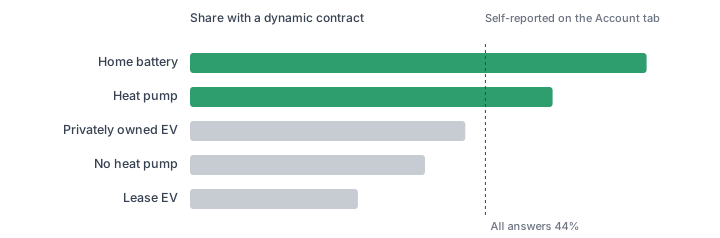
The home battery sits at the top, and that is no coincidence. A battery only earns something when the electricity price moves. Whoever buys one usually has the contract already. The heat pump follows the same logic: a large, controllable load makes a dynamic contract attractive.
Lease drivers sit at the bottom. Not from lack of interest, but from arithmetic. The lease company reimburses home charging per kWh, at the rate of your energy contract. Go dynamic and charge cheaply, and that reimbursement drops with it. Smart charging costs a lease driver money. So you just charge at five.
Solar panels alone do nothing
This was the result that surprised us. You would think: whoever has solar panels charges at midday. That is only true when there is a dynamic contract as well.
| Household | Midday (10:00 to 16:00) | Evening peak (17:00 to 21:00) |
|---|---|---|
| Solar panels and a dynamic contract | 43% | 24% |
| Solar panels, no dynamic contract | 30% | 34% |
| No solar panels, dynamic contract | 34% | 25% |
Solar panels without a dynamic contract charge exactly like a household without panels: 30% at midday, 34% in the evening peak. The panels are on the roof, but the behaviour does not change. As long as net metering exists, the hour you charge makes little financial difference.
The contract does the work, not the roof. As soon as the electricity price differs per hour, the car charges at midday. With or without panels.
A home battery reinforces that: households with a battery charge 45% of their kWh at midday and 23% in the evening peak. Smart control through an energy management system does the same: 41% at midday, against 33% for households without.
Which supplier, which behaviour
The energy supplier is the strongest predictor we have. Not because the supplier charges smartly, but because the contract decides whether the hour of charging costs money.
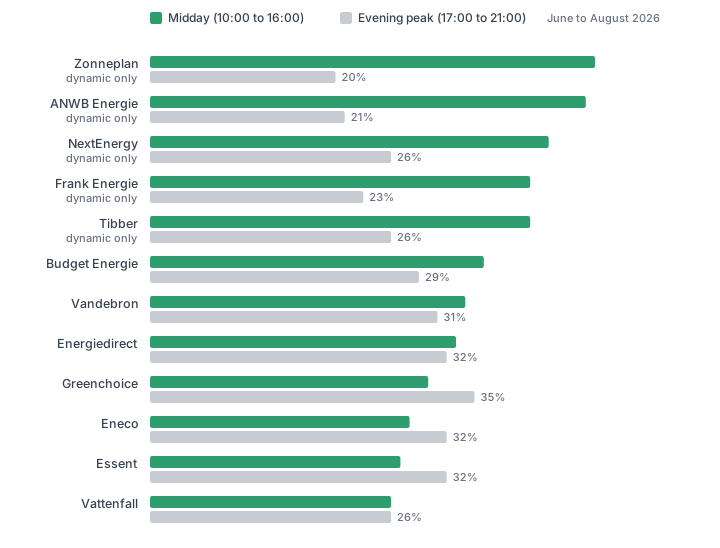
The top five only sell dynamic contracts. Below them the fixed tariff begins, and there charging shifts to the evening.
Two outliers. Essent customers charge at night most often: 12% of their kWh after 23:00. That looks like an old day-and-night tariff still doing its job. And Vattenfall customers spread out the most: little at midday, but little in the peak too.
The charger follows the household
Does the charger brand say anything about smart charging? A little. Mostly because every brand has its own audience.
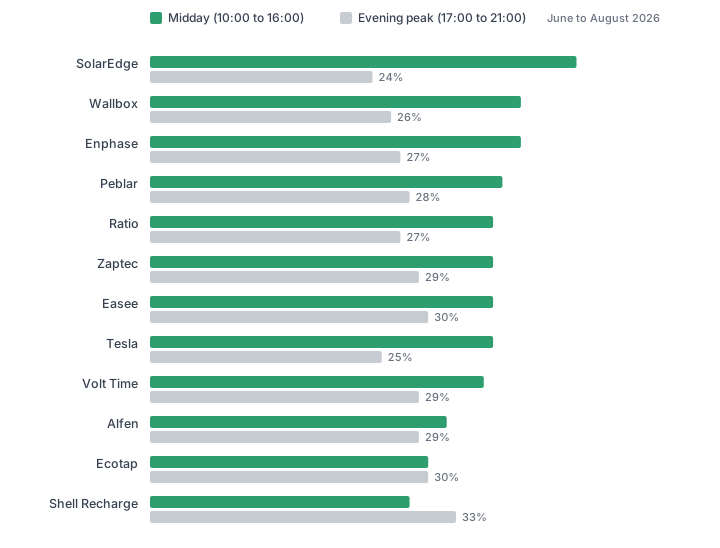
SolarEdge and Enphase sit at the top, and those are inverter brands. Almost every household with such a charger has solar panels. At the bottom are Shell Recharge and Ecotap: chargers that often arrive through the lease company or the installer. At Shell Recharge, more than eight in ten households that answered the question are lease drivers. The same group that picks dynamic least, and that charges at 17:00.
Within one brand the contract decides everything. Take Peblar: with a dynamic contract, 49% of the kWh goes at midday and 17% in the evening peak. Without, that is 35% and 33%. At Alfen: 44% against 32% at midday. At Zaptec: 43% against 33%. Same charger, different household, different pattern.
So do not buy your charger to charge smartly. Every modern charger can do that, through your supplier's app, your car or an energy management system. Buy it for what it has to do: fit your connection, connect to Joulo, and carry a factory-fitted MID-certified meter.
What this means for your ERE credits
For your ERE credits the hour of charging makes no difference. Every kWh your charger meters counts, at noon or at three in the morning. Smart charging lowers your electricity bill. ERE credits pay per kWh. The two stack.
How that works with a dynamic contract is on our page about dynamic contracts (in Dutch). And why smart charging will soon earn a separate reward as well is in our article on grid congestion (in Dutch).
Method
The figures come from anonymised charging sessions on the Joulo platform from 1 June to 31 August 2026. The sample: over 23,000 households, over 900,000 charging sessions and almost 18 million kWh. We only count chargers with an automatic connection (cloud or OCPP). Sessions without recorded energy or under half a kWh do not count. Every session counts in the hour it starts.
Customers fill in the household profile themselves on the Account tab of the dashboard. That is voluntary, and whoever fills it in has solar panels more often than the average customer. The percentages per household type are therefore an indication, not a national picture. We also assume a dynamic contract when the supplier only sells dynamic contracts. "Unknown" never counts as "no".
Suppliers and brands with too few households are left out.
About the author
Co-founder of Joulo. Previously EV infrastructure at KPN and ServiceHouse. Writes about ERE, energy and regulation.

About Joulo
Joulo is an ERE booking service provider for residential charging sessions.
34,000,000 MID kWh this year (forecast)
The ERE backend for CPOs and energy companies, under their own brand.
White-labelJoulo B.V. • Own account with the NEa • in line with RED III
Newsletter
Stay in the loop
The occasional email on ERE, chargers and earning from home charging. No spam, unsubscribe anytime.
Earn on every kWh you charge at home
Connect your charger once. We register your sessions and pay out every quarter. 20% service fee, cancel yearly.